
John, an anaerobic digester facility owner, is proud of his operations. Over the last couple of years, he and his team have weathered through unclogging sticky feedstock pumps, foam spilling out from the digester overflow pipe, and many more tough (and stinky) challenges! He learned how to keep the microbes happy so that they produce lots of biogas. Now, John wants to grow his business by producing more biogas. He searches for meat processors, slaughterhouses, and rendering facilities that produce fatty wastes because adding fat will boost his biogas production.
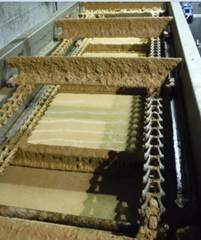
He secures dissolved air flotation (DAF) waste from various sources. DAF waste is gold to him: just 30 tonnes of watery-fatty DAF waste could get him 100 GJ of RNG. He knows from experience that he needs to approach adding fat to the digester carefully. Increasing the organic loading rate (OLR)—the measurement for how much feed goes into the digester—too hastily could stress the microbes and lead to another messy foam event. John understands that the microbes that produce his biogas are living beings and he doesn’t want to stress them out.
Outside of work, you can find John competing at local swim meets and volunteering as a swim coach at the nearby high school. He starts approaching increasing the organic loading rate like how he trains for a swim meet. His training plan (and high fat operations plan) looks something like this:
- Start swimming more often (adding loads of fat to the digester more frequently),
- Swim harder at each session (add larger volumes of fat),
- Eat healthier (balance fat with other feedstocks), and
- Maybe get new gear (fix any mechanical issues).

Sometimes he takes training too far and suffers a minor strain. All athletes know what it’s like to push themselves a little too far past their capabilities and get injured. When you push the OLR or fat feed too far for a digester, the microbes can get “injured” too:
- Minor injuries look like unstable gas production that resolves itself after a week or so, and
- Major injuries look like a surge in gas production that suddenly drops.
What John doesn’t realize is that running a high fat digester is less like competing at a local swim meet and more like competing at the Olympics. They have their similarities like training more often, training more rigorously, eating healthier, and getting the right gear, but all at a more sophisticated level. And with Olympians, they are accompanied by expert support teams made up of nutritionists, doctors, physical therapists, coaches, etc. Their support team uses specialized knowledge to help train the athlete while the athlete focuses on performing at their best. Similarly, digester owners like John can lean on specialists like Azura to manage their feeding plan while they focus on operating day-to-day.
This is an overview of how digester owners can successfully transition to high fat digester operations like an Olympic athlete.
Step 1: Know Yourself
Nutrition and Health Checkup
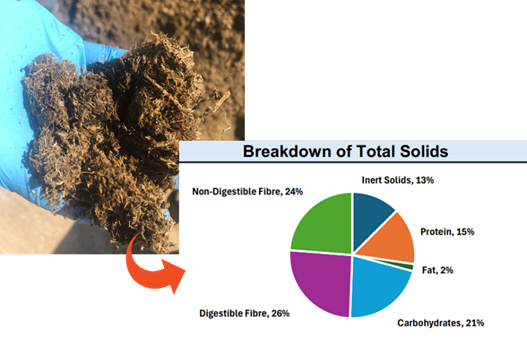
An Olympic athlete will consult their nutritionist and doctor to understand their physical state. John would similarly examine his digester’s diet. Azura suggests John take samples of the feedstocks that make up 70%-80% of the total annual volume of feedstocks that he receives, then send them to a lab for feedstock characterization testing. Good feedstock characterization testing quantifies how much carbohydrates, proteins, fats, and fibres the owner is feeding the digester most of the time. We also recommend digestate testing (very similar to taking an athlete’s blood test) to scan for potential health concerns.
System Check Before Feeding More Fat
Sometimes doctors suggest delaying or stopping the athlete from increasing the difficulty of their program. With Azura’s experience across many clients that we’ve guided through high fat digester operations over the last 30 years, we’ve created two heuristics to check:
- The digester’s hydraulic retention time (HRT) is greater than 18 days. It’s possible to digest fats at a shorter HRT, but that’s Olympic -level performance. You need your digester well dialed in to get there.
- Fat makes up less than 20% of the volatile solids (VS) of your total weekly blend of feedstocks.
If these two heuristics apply to you, then you have room to increase the fat in your digesters. We don’t have room to explain the science behind these heuristics in this article, but if you have a question then feel free to contact us at learn@azuraassociates.com.
Ideal System Features
Often, digester facilities aren’t originally designed and constructed to take a lot of fat. If you are in the design stages and know that you will have a lot of fatty feedstocks, here are Azura’s top four wish list items for your system:
- Control over when and how much fat you can feed at a time
- Building a separate feedstock tank only for fatty waste or spreading out your fat receiving schedule will give the operators more control options.
- A hydrolysis or fermentation tank
- The feedstock tank can become a hydrolysis or fermentation tank when it is well heated, well mixed, and the liquid level remains relatively high.
- A mixer inside the digester that can break up floating crust or foam
- Fats can float and form a crust in the digester that can cause mechanical and biological issues. The biological issues can cause foam, which is a major operational headache.
- A habit of frequent digester health monitoring and precise OLR measurements
- Digester health monitoring and precise OLR measurements are done with discipline rather than with gear.
Our wish list items help owners like John operate a digester facility that can weather many of the headaches that high fat operations can bring.
Step 2: Preparation
Creating a diet for champions
Your nutritional checkup (i.e., feedstock characterization results) will help you identify feedstocks that could be cut out from your diet. We recommend minimizing feedstocks that have:
- Low fuel value (e.g., feedstocks with more water than fuel value)
- Low nutritional value (e.g., too much non-digestible fiber and inert solids)
Similarly, your blood test (i.e., digestate testing results) will help you identify any mineral or micronutrient deficiencies like cobalt or selenium. Mineral and micronutrient deficiencies can be fixed with supplements or a better diet. This is important: most digesters, especially farm digesters with dairy manure, will not need supplements—but higher fat digesters often do.
Fixing health concerns before competing
John wouldn’t start speed work on a strained shoulder, so he shouldn’t push fat loading when his digester biology is already limping. If the microbes are under stress, adding more feed can be the thing that tips them from “recovering” to “failing.”
Watch for these signs that you need recovery time before you increase feed:
- Volatile fatty acids (VFAs) climbing above 4,000 mg/L
- Long chain fatty acids (LCFAs) building up
- Foam showing up
- pH changing from normal, e.g. increasing beyond 7.8, or dropping (especially below 6.8)
Bringing the digester back to a healthy baseline typically takes 2 to 4 weeks, depending on what’s driving the stress and how far it’s progressed. Once the system is healthy and steady again, then it’s safe to start increasing the feeding rate.
First Aid Kit
All athletic competitions have a first aid kit on hand in case of emergency. The microbe first aid kit can help operators react quickly to concerning trends:
- A plan to be able to back-off on the feeding a few days
- pH correctors like magnesium hydroxide (MagOx) when the pH gets too low
- Dilution water for high ammonia or toxic compounds
- Iron additives like iron chloride liquid or iron hydroxide powder for hydrogen sulfide spikes
With good nutrition, no illnesses, and a first aid kit ready, the digester can now compete at the Olympics!
Step 3: Competing at the Digester Olympics
How to Safely Ramp up the Organic Loading Rate
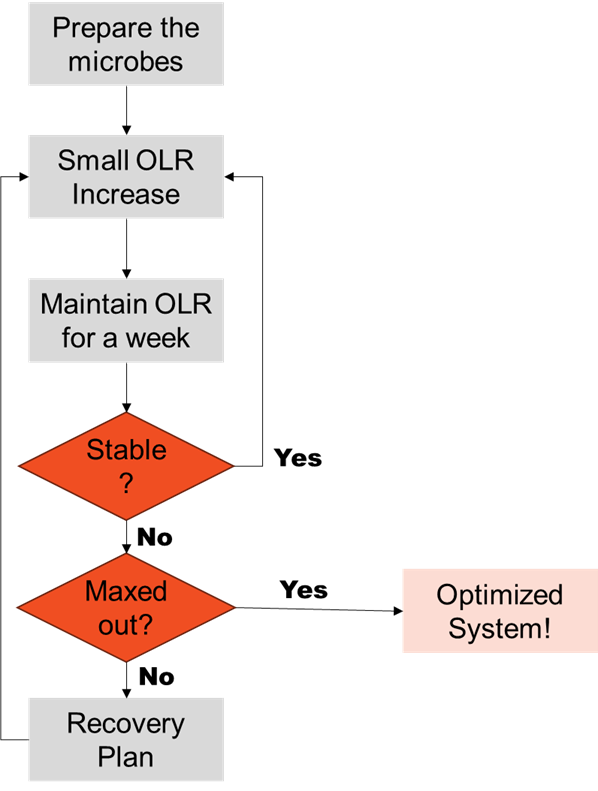
Increase the OLR by 10% at a time
Like athletes, the microbes perform better with progressive overload where gradually increasing stress forces the microbes to adapt. Azura recommends increasing the OLR by approximately 10% at a time for a safe and conservative progression. The likelihood of instability increases when the OLR is increased more than 10% at a time, but it is possible depending on the site specific and feedstock blend factors. An expert can advise you on when it is safe to be more aggressive in your feeding. Remember the tortoise and the hare? The tortoise wins every time!
All the microbes to stabilize for at least a week
The microbes need time to adapt to the OLR increase. One week is often enough time for the microbes to adapt when the OLR increase is not overwhelming. Overshooting the OLR can cause some minor instability and then the microbes may need more than a week to adapt. Only continue with increasing OLR after the system has stabilized.
Go back to step 1, unless the system is unstable
Fix instability with a recovery plan
All athletes can get too enthusiastic in their training and suffer injuries while training at some point in their career. Minor injuries can be resolved by resting a couple of days. Major injuries need stronger interventions. The most common type of digester microbe injury happens when they are overfed.
People overfeed the digester for various reasons like:
- The feedstock composition changed unintentionally due to feedstock variability
- The feedstock volume increased due to variability
- Business & investor pressure to tighten the timeline
- Impatience
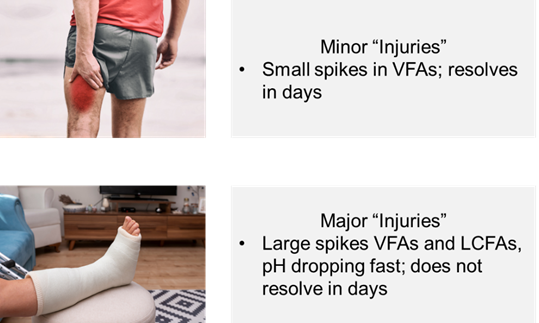
Minor injuries look like small spikes in VFAs that resolves within days. In these cases, maintain the OLR for a week and let the microbes adapt to the new baseline.
Major injuries look like large spikes in VFAs, LCFAs, pH dropping fast, and does not resolve within days. In these cases, reduce or stop feeding entirely. If the pH drops below 7.0, then add alkaline. If pH drops below 6.5, you’ll need more aggressive help. Overfeeding can kill the microbes when severe enough, and you might even need to restart the entire process again.
Two simple checks can tell you whether your digester is running at (or near) its true capacity:
- Your overall system HRT is around 18 days
- How much you can feed is partly limited by total liquid volume. Once you’re at ~18-day HRT, the easiest way to push more into the digester is to increase solids concentration (i.e., get higher-solids feedstocks) rather than more gallons.
- You can’t increase OLR without triggering instability
- Feeding is also limited by biology—specifically, how much active microbial capacity your system can support. If even small OLR increases consistently lead to rising VFAs/LCFAs, foam, or a pH slide, you’ve likely hit the practical food-to-microbe limit for your digester.
If you’ve reached your system’s maximum, congratulations!

Conclusion
Running high-fat digesters requires the discipline of an Olympian: know your baseline, clean up the diet, ramp in controlled steps, and respond fast when the biology shows strain. Do that well, and fat becomes a reliable performance boost instead of a recurring foam-and-VFA headache.
Want to know how close you are to your current “Olympic ceiling”? Email Azura at learn@azuraassociates.com for a high-fat operations consult. If you send your weekly feed volumes, %TS/%VS (or recent lab results), and digester working volume, we’ll do a quick HRT and fat-%VS check and outline a conservative ramp plan tailored to your site.
An abridged version of this article appeared in Biogas World Magazine. Check out the magazine here.
Get Insights from the Bioprocess Experts Right to Your inbox
Sign up to the Discover Digesters Newsletter to access Azura’s best practices, field-tested advice, and insights into the anaerobic digestion & industrial wastewater treatment industries.
By submitting this form, you are consenting to receive marketing emails from: Azura Associates. You can revoke your consent to receive emails at any time by using the SafeUnsubscribe® link, found at the bottom of every email. Emails are serviced by Constant Contact.